
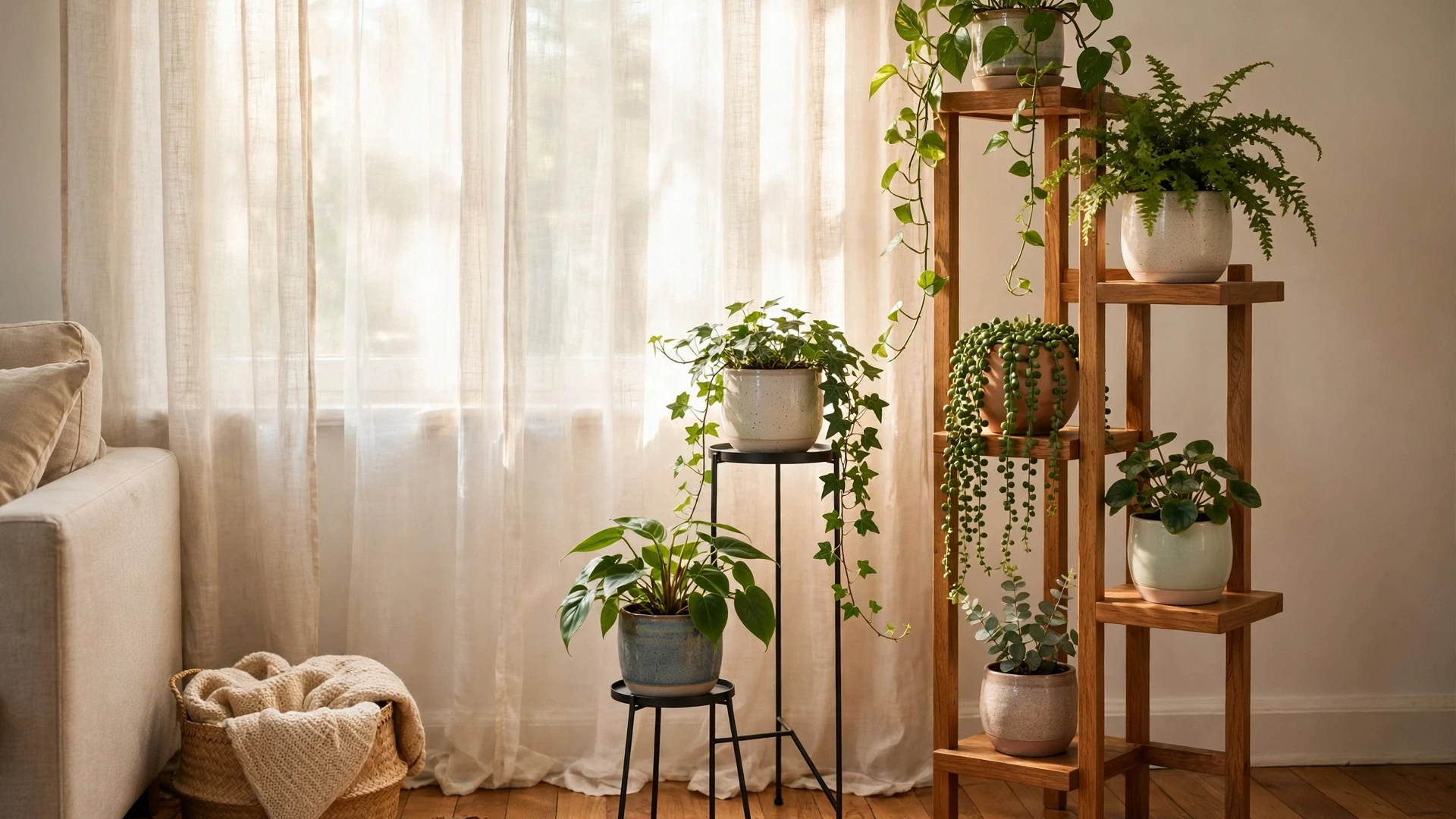
I used to keep all my plants on the floor or crowded together on one windowsill, and the result always looked a little accidental — pots in a row, leaves fighting for light, and one sad plant slowly giving up in the corner. Then a friend gave me a simple wooden plant stand, and I put a trailing pothos on it beside the sofa. That one small lift changed everything. The plant suddenly had presence, the corner looked finished, and the whole room felt taller and calmer. A plant stand does more than hold a pot — it gives your greenery a stage, and it turns a plant into a piece of decor.
Here are five plant stand styling ideas that will help you bring that fresh, layered feeling into your own home.
1. Play With Height to Create a Little Green Corner
The easiest way to make plants look intentional is to vary their heights. Put a tall plant stand in the corner with a leafy plant on top, a shorter stand beside it, and one pot on the floor, and you have a small indoor garden instead of a row of pots. The different levels lead your eye upward and make the whole corner feel designed rather than improvised. If you only have one stand, place it where the room feels empty — a bare corner, the end of a hallway, or beside an armchair — and let the height do the work. For more ways to let greenery shape a room, take a look at our Plant Styling Ideas, which pairs beautifully with the height tricks here.
2. Mix Materials for a Look That Feels Collected, Not Matched
A plant stand does not have to match everything else in the room. In fact, a mix looks better. A warm wooden stand suits a rattan basket and a terracotta pot; a slim black metal stand looks sharp next to a white ceramic pot and a glass vase. Try combining two different materials in the same corner — wood and metal, or bamboo and ceramic — and keep the plants themselves the common thread. The contrast makes each piece stand out, and the corner feels collected over time rather than bought in one trip.
3. Let One Plant Trail and One Plant Stand Tall
A trailing plant is a plant stand’s best friend. Let a pothos or a string of pearls spill over the edge of a high stand while a upright plant — a snake plant, a fiddle leaf fig, or a palm — rises beside it, and you get movement in two directions at once. The trailing leaves soften the stand’s lines, and the tall plant gives the arrangement structure. Just keep the trailing plant away from walkways, or you will be brushing leaves every time you pass. When the stand sits near a shelf or a table, a small vase beside it can echo the greenery — our Vase Styling Ideas has simple ways to make that pairing feel effortless.
4. Style the Stand Like a Small Shelf, Not Just a Pedestal
A plant stand with two or three tiers is really a small shelf, so style it like one. Put the plant on the top tier, a stack of two books and a tiny candle on the middle tier, and a woven basket or a small ceramic on the bottom. The trick is to leave breathing room — if every tier is packed, it reads as clutter, not styling. One empty spot is not a mistake; it is what makes the rest look deliberate. This layered approach also works wonderfully alongside a bookcase — if you enjoy styling shelves, our Bookshelf Styling Ideas shows how to keep layers looking curated rather than crowded.
5. Move the Stand With the Seasons and the Light
Plants follow the light, and your stand should follow the plants. In winter, move the stand closer to the brightest window; in summer, pull it back a little so harsh afternoon sun does not scorch the leaves. A plant stand makes this easy because the plant travels with it, pot and all, without dragging soil across the floor. While you are at it, rotate the stand a quarter turn every couple of weeks so the plant grows evenly instead of leaning toward the window. A stand that moves with the seasons keeps both the plant and the room looking alive all year.
Mistake to Avoid
The most common plant stand mistake is choosing a stand that is too small for the pot. A top-heavy plant on a narrow stand tips over at the worst moment — usually at night, usually onto a rug. Before you buy, check that the stand’s top is at least as wide as the pot’s base and that the stand feels steady when you nudge it. A plant that falls once will lose leaves and your confidence; a stand that fits properly will hold it safely for years.
A plant stand is one of the smallest, cheapest changes you can make to a room, and one of the most satisfying. Start with a single stand and a plant you already own, find it a corner with decent light, and live with it for a week. You will probably find yourself looking at that corner more than any other spot in the room — and planning where the next stand should go.
Leave a Reply