I bought my first pouf on a whim, mostly because it was on sale and looked soft. I had no plan for it, no spot picked out, and honestly no idea what a pouf was even supposed to do in a room. It sat in the middle of my living room for a week, looking slightly lost, until I moved it next to the armchair — and suddenly the whole corner made sense. That is the quiet magic of a pouf. It is small, soft, and easy to move, yet it can change how a room feels and how you actually use it. A pouf can be a footrest, an extra seat, a side table, or simply the soft shape that makes a room look finished. Here are five pouf styling ideas that helped me get the most out of mine.
1. Use It as a Footrest Beside Your Favourite Chair
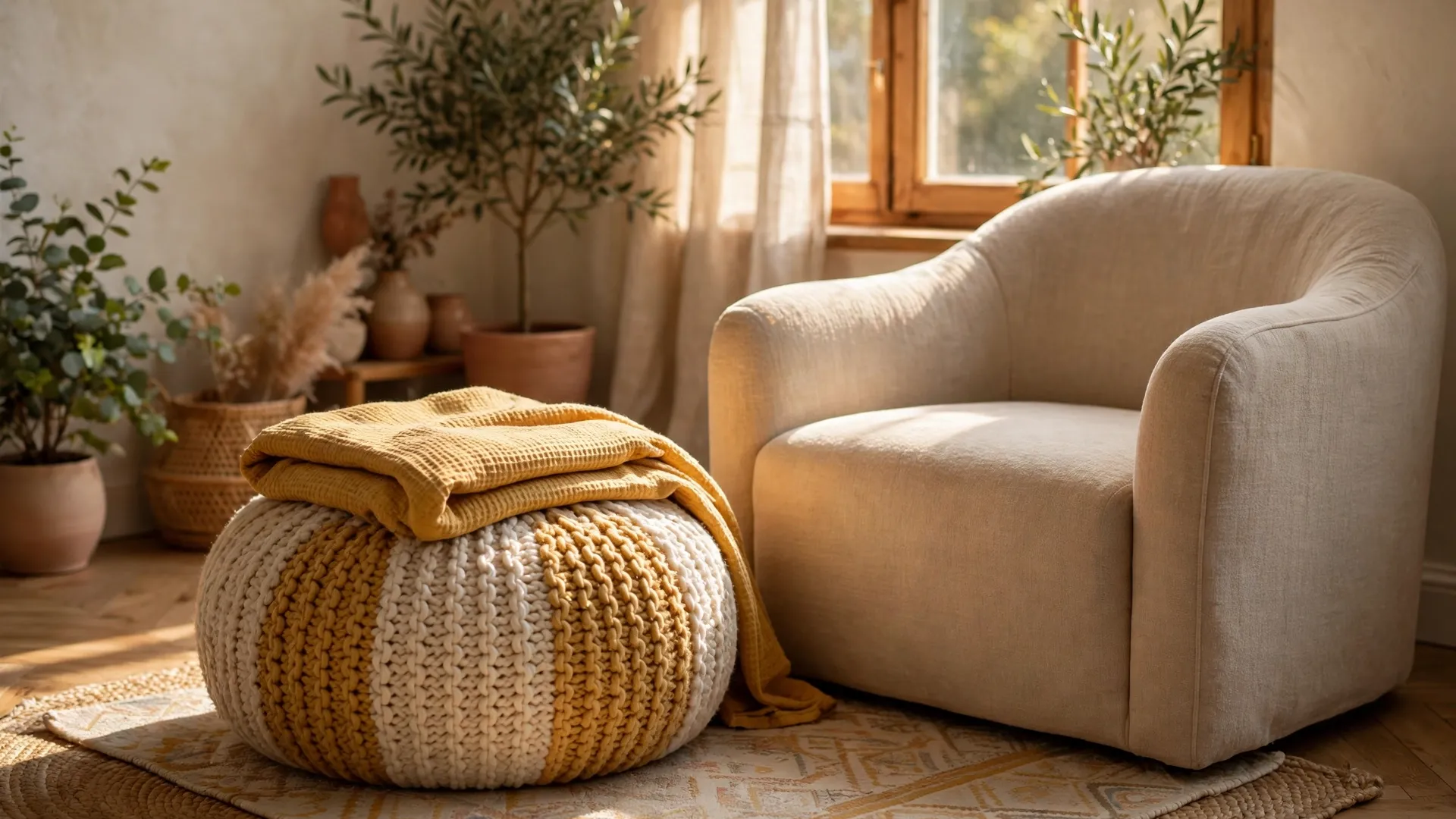
The simplest job for a pouf is also the most satisfying one. Place it in front of your favourite reading chair or sofa, close enough that you can rest your feet on it without stretching, and the whole seat becomes ten times more comfortable. I keep mine beside the armchair where I read in the evenings, and it has turned that chair into the spot everyone in the house wants. Choose a pouf that is roughly the same height as the seat of the chair, or a little lower, so your legs rest naturally. A soft woven or knitted pouf feels lovely under bare feet, while a leather or faux-leather one wipes clean easily. If you are styling the chair itself too, my guide to Accent Chair Styling Ideas That Make Any Corner Feel Inviting and Beautiful has more ideas for making a single chair feel like a destination.
2. Let It Be the Extra Seat When Guests Arrive
A pouf is the easiest extra seat you can own, because it does not need a permanent home. When friends come over, I pull the poufs out from beside the sofa and scatter them around the coffee table, and suddenly there is room for everyone without dragging heavy chairs across the room. Round poufs work best for this, since they have no corners and no wrong way to sit on them. Keep one or two in a bedroom or hallway when they are not in use, so they are easy to grab but never in the way. Firm, well-stuffed poufs hold their shape better as seats, so press the top before you buy — if it sinks too far, it will feel more like a cushion than a chair.
3. Style It as a Soft Coffee Table
When the coffee table is full of books and cups, a flat-topped pouf can take over as a second surface. Place a sturdy tray on top and you have a spot for a cup of tea, a small vase, or a candle, right where you need it. I use this trick in my living room on busy evenings: the tray comes off when someone wants a footrest, and goes back on when we want a surface. A round tray works best on a round pouf, and a tray with a rim keeps things from sliding off. This works especially well if your room already has soft layers underfoot — my Rug Layering Ideas That Make Your Living Room Feel Warm, Stylish and Finished shows how to build that cosy base, and a pouf sits beautifully on top of it.
4. Add Colour and Texture Without Committing to Big Furniture
A pouf is a low-risk way to try a colour or texture you love but are not ready to commit to on a sofa. A deep green velvet pouf, a mustard knitted one, or a patterned Moroccan-style pouf can bring a whole room to life for very little money, and if you change your mind next year, moving it to another room is easy. I like to pick a pouf in a colour that appears somewhere else in the room — a cushion, a throw, a piece of art — so it feels connected rather than random. If your room is mostly neutral, a pouf in a warm, rich tone is often all it takes to make the space feel styled instead of plain.
5. Tuck a Pouf Into a Corner to Soften Hard Edges
Every room has a corner that feels a bit sharp or empty — beside a bookshelf, at the end of a sofa, or under a window. A pouf softens those spots instantly because its shape is round and low, which breaks up all the straight lines of furniture and walls. I placed a small pouf in the empty corner beside my bookshelf with a folded throw draped over it, and that corner went from forgotten to favourite. If you already use an ottoman in your living room, a pouf plays a similar role on a smaller scale — my Ottoman Styling Ideas That Make Your Living Room Feel Soft, Stylish and Complete covers the bigger version of this idea, and the two can even sit in the same room if their colours work together.
Mistake to Avoid
The mistake I made with my first pouf was buying the wrong size for the room. It was too big for the corner I had in mind, so it blocked the walkway and looked bulky instead of soft. Measure the spot before you buy, and leave at least a little breathing room around the pouf — a pouf that is squeezed in looks cluttered, while one with space around it looks intentional. As a rough guide, a pouf should be smaller than the chair or sofa it sits beside, and it should never block a doorway or a path through the room.
A pouf is a small piece with a big job: it makes a room softer, more comfortable, and more flexible, all at once. Start with one — beside your favourite chair, at the end of the sofa, or in that empty corner — and live with it for a week. You will probably find yourself moving it around the house, and that is exactly the point. The best pouf is the one that gets used every day, in a different spot each time.
Leave a Reply